

— Technique —
How to Equalize Your Ears — and What to Do When You Can't
Equalising your ears is the single most common thing new divers struggle with, and also one of the most preventable. The concept is simple: as you descend, the water pressure rises and squeezes the air space behind your eardrum, so you add a little air to that space to balance it. The catch is that most people are taught only half of it — the technique, but not the habit that makes the technique work. The secret isn't a stronger push; it's equalising early, often, and gently, before your ears ever start to hurt. Here's what's actually happening, the techniques worth knowing, what to do when one ear won't clear, and when a dive simply isn't worth pushing.
Why it's the first real hurdle
Ask any new diver what tripped them up and “my ears” comes up more than anything else. It's also where instinct betrays you: when an ear won't clear, the natural urge is to pinch harder and blow harder — which, as we'll see, is close to the worst thing you can do. Get the habit right and equalising becomes something you barely think about. Get it wrong and it can end a dive, or an eardrum.
What's actually happening in your ears
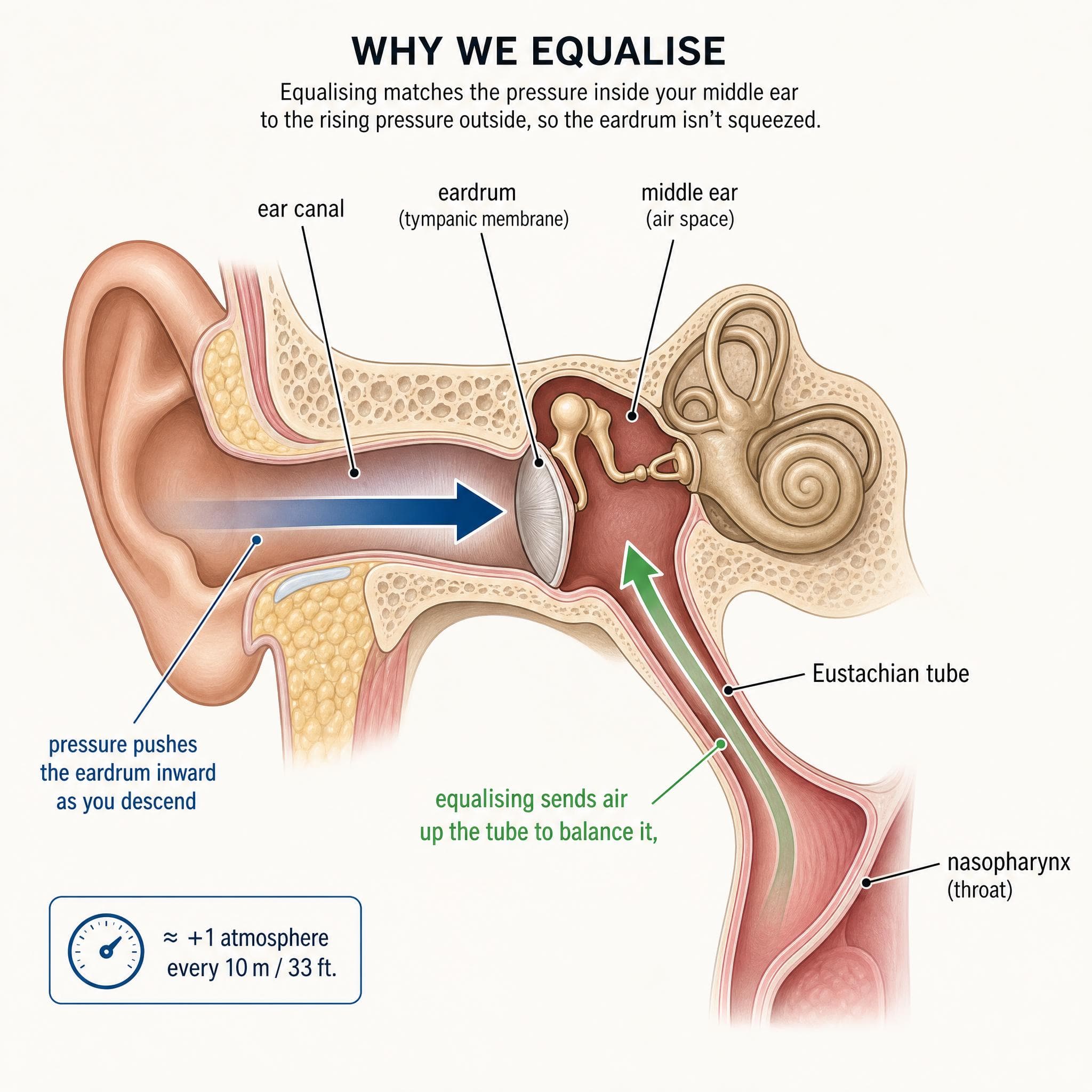
Behind each eardrum sits a small air-filled space about the size of a pea, connected to the back of your throat by a narrow passage called the Eustachian tube. On land, that tube quietly does its job every time you swallow or yawn.
Underwater, the maths moves fast: pressure rises by a full atmosphere for every 10 metres (33 feet) you descend, and all of it pushes your eardrum inward. To stop the squeeze, you have to open the Eustachian tube and let a little air travel up into the middle ear to match — that's all equalising is. Miss it, and the pressure difference causes pain and, pushed far enough, barotrauma: a bruised or ruptured eardrum.
The golden rule: early, often, and gently
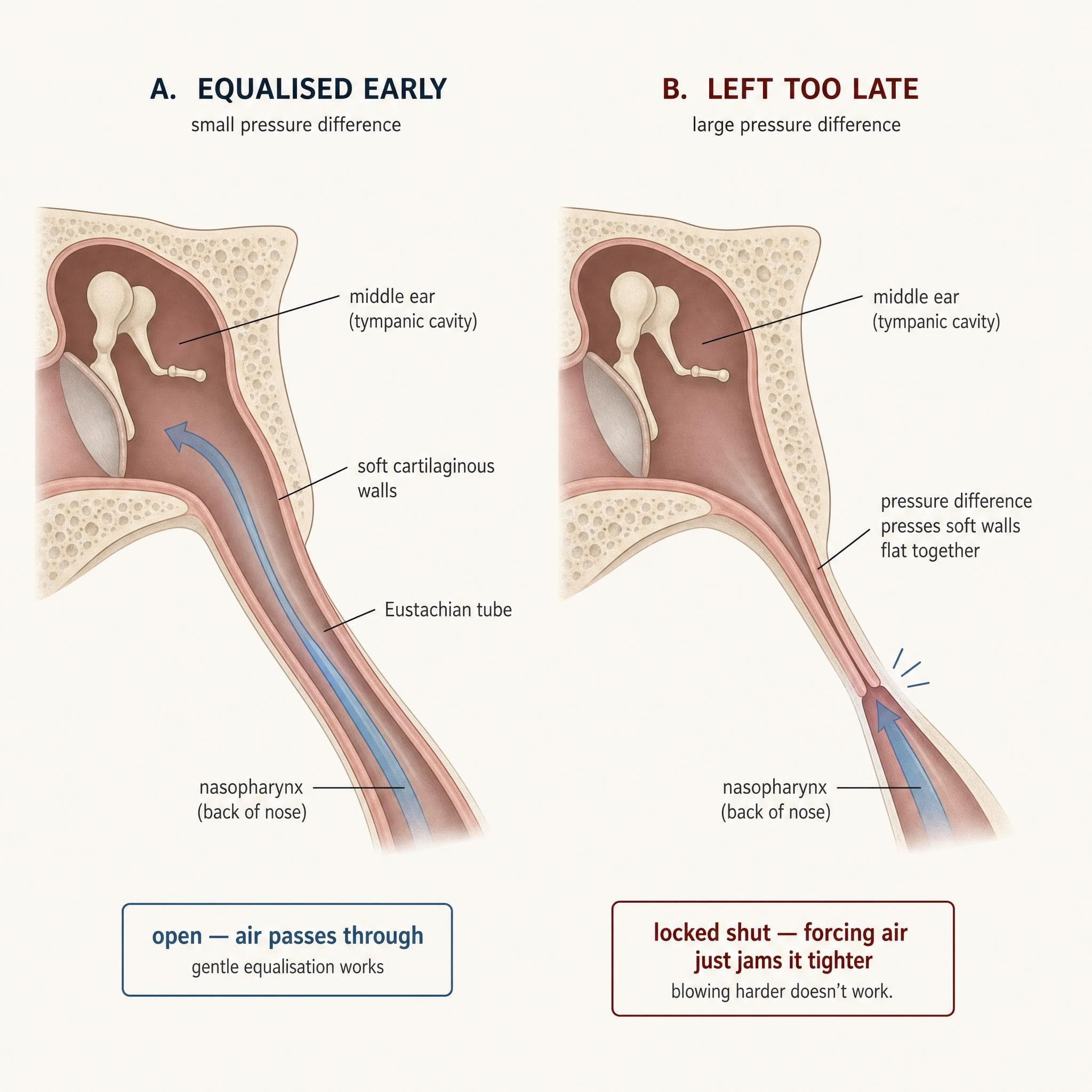
Here's the piece most divers are never told. The pinch-and-blow method nearly everyone learns — the Valsalva manoeuvre — doesn't actively open your Eustachian tubes; it forces air up against them. That works beautifully as long as you stay ahead of the pressure. But if you let yourself fall behind, the growing pressure difference presses the soft walls of the tube together and effectively locks them shut — and now blowing harder only jams them tighter while getting no air through. Worse, a really forceful blow can injure the delicate windows of your inner ear, which is a far more serious problem than a sore eardrum.
So the whole game is staying ahead of it. Equalise gently once before you even leave the surface, then again every metre or so on the way down — at a normal descent rate, that's roughly every few seconds. Equalise before you feel anything; if your ears are already aching, you've left it too late. Descend slowly and feet-first where you can, because that lets air rise naturally into the tubes and helps fluid drain away from them — and use a line or a slope to control your speed rather than dropping like a stone. Do all of that, and you may simply never have an ear problem again.
The techniques worth knowing
Valsalva (pinch your nose and blow gently) is the one you were taught, and it's a perfectly good starting point. But it isn't the only tool, and if it keeps failing you, the fix is almost always a different technique rather than more force. Three are worth knowing, and a fourth trick pairs well with all of them.
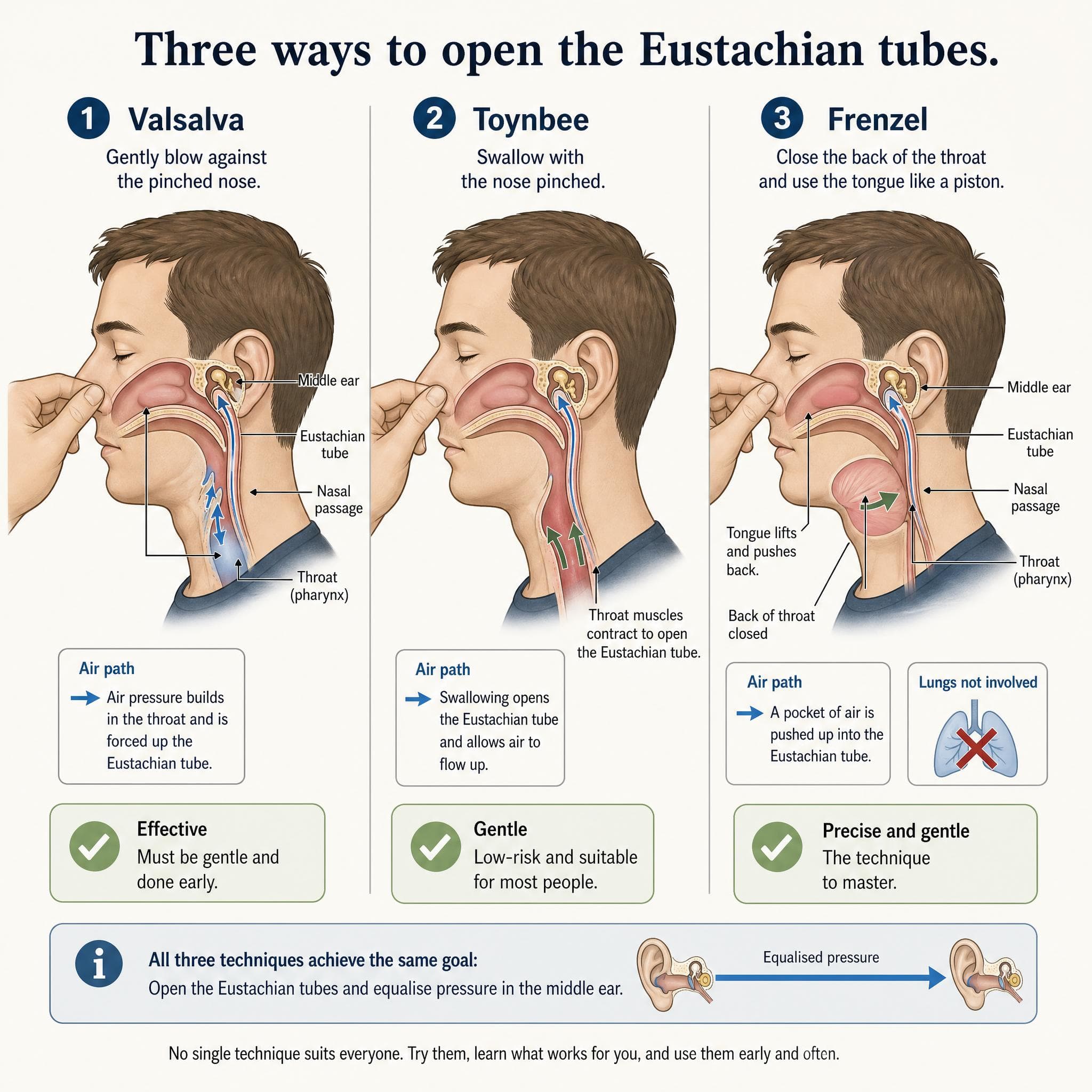
- Valsalva: pinch your nose and blow gently. The one most people are taught — a fine starting point, but never forceful.
- Toynbee: pinch your nose and swallow. This pulls the tubes open with muscle rather than pushing air at them, so it's gentle and low-risk.
- Frenzel: pinch your nose, close the back of your throat as if starting to say “K,” and push your tongue up and back like a piston, sending a small, controlled puff of air into the tubes without involving your lungs at all. Gentler, more precise, and the method most freedivers swear by — if you're a persistent struggler, this is the one to learn.
- Wiggle and swallow: jutting your jaw forward and down, swallowing, or yawning all help open the tubes, and pair well with the above.
The useful truth here — the same one that turns up with trim and weighting — is that no single technique fits everyone. Some people never get on with Valsalva and are transformed the moment they learn Frenzel. Finding your method is half the battle.
When one ear won't clear
Here's the situation almost every diver knows. You're a few metres down, an ear won't go, and a little voice starts up: I can't get down — everyone's waiting on me. That pressure is the real problem, because it pushes you into the one thing you shouldn't do: force it, and keep sinking in the hope it'll pop. It won't.
The counter-intuitive fix is to go the other way. Ascend a metre or two — not all the way back to the surface, you're not trying to yo-yo, just enough to take the load off the tube — and try again, gently, from there. If you're on a reef or a slope rather than a fixed line, it's easier still: hang a little shallower and follow the group along at that depth, then ease down slowly once your ears agree. There's rarely any real need to force a descent to a set depth on a schedule. (The exception is a strict vertical-line descent for a specific reason — a current, a drift entry, a planned profile — where you'd manage it differently.)
A few habits worth keeping
A surprising amount of your equalising is decided the night before. Dry air is the quiet culprit: sleeping under strong air-conditioning dries out and irritates the membranes in your nose and sinuses, which swells the tissue and thickens the mucus your Eustachian tubes have to open — the same thing dehydration does from the inside. So go easy on the aircon the night before a dive day (a fan is much kinder to your sinuses, if you can use one instead), and turn up properly hydrated. It's one more reason to get your water in early — it keeps everything that has to move, moving.
Beyond that: don't dive with a cold or congestion (swollen tubes won't open, whatever your technique), and be cautious about leaning on decongestants — they can wear off at depth and leave you with a painful “reverse block,” where expanding air struggles to escape on the way back up. And if you're ever unsure about your ears, DAN's hotline exists for exactly these questions.
My take
The thing I most want a new diver to hear is this: the reason people force their ears is almost never the ears. It's the feeling that everyone's waiting — the group's already down there, the guide's looking up, and you don't want to be the one holding things up. So you push, and you sink, and you make it worse. Half of teaching equalising well is simply giving people permission to ignore all that — to stop, to go back up a metre, to take the extra thirty seconds, without a shred of guilt. I'll have someone practise the techniques dry, on land, before we're anywhere near the water, and then we go slowly, feet-first, equalising before we leave the surface and every breath or two after — and if it's not working, we just take the time, because the reef isn't going anywhere and no one worth diving with is actually annoyed. Nine times out of ten, a diver who was told they “can't equalise” just needed a gentler habit, a switch to Frenzel, or permission to slow down.
The short version
Equalise gently, before it hurts, starting on the surface and repeating every metre or so as you descend slowly and feet-first. If an ear won't clear, don't force it and don't let the group rush you — ascend a metre or two to take the pressure off, try a different technique, and ease back down; if it still won't go, calling the dive is completely fine. Learn more than one method (Frenzel is the one worth mastering), turn up hydrated and easy on the aircon, and skip diving with a cold.
Getting comfortable with your ears is one of those quiet skills that separates a relaxed diver from a stressed one — and, like most of diving, it's made through patient practice, not printed on a card. If you'd like unhurried help finding the technique that works for you, that's exactly the sort of thing we take the time to get right.
Sources
- Divers Alert Network — “Ears & Diving” and “6 Methods to Equalize Your Ears” (equalise early and often; the Valsalva lock-out mechanism; inner-ear risks of forceful blowing; feet-first descent). dan.org
- PADI — “Ear Equalization and Ear Care for Scuba Divers” (techniques, congestion and decongestant cautions, the dairy myth). blog.padi.com
- DAN / Scuba Diving — “Ask DAN: Equalization & Ear Injuries” (warning signs, barotrauma symptoms, when to end diving). scubadiving.com
- E. Kay / DAN — equalisation technique descriptions (Toynbee, Frenzel, Lowry, Edmonds, and hands-free BTV).